HealthLive on the App Store
iOS case study
MedicaProf
A patient health app for France and Syria: find and book doctors, join video visits, keep a medical record and sync Apple Health, in English, French and Arabic.
- Client
- MedicaProf · France
- Role
- iOS Engineer
- Platform
- iPhone & iPad · iOS 17+ · English, French & Arabic
- Scale
- ~74K lines of Swift in 386 files · 8 feature modules · 2 country backends
The challenge
Give patients one app to find doctors, book and attend visits, and keep a medical record they own, while treating health data with strict privacy.
What the app does
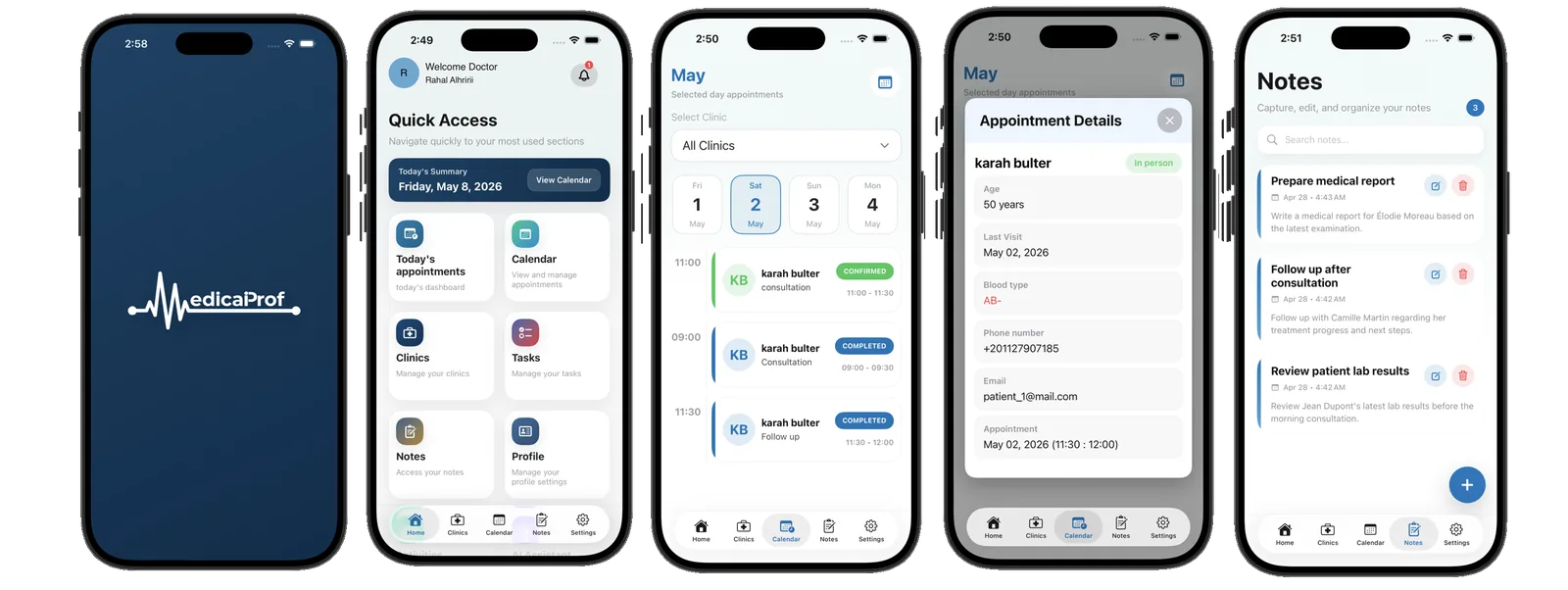
- Sign-in with optional two-factor codes, trusted devices that skip the code on later logins, and Face ID / Touch ID login.
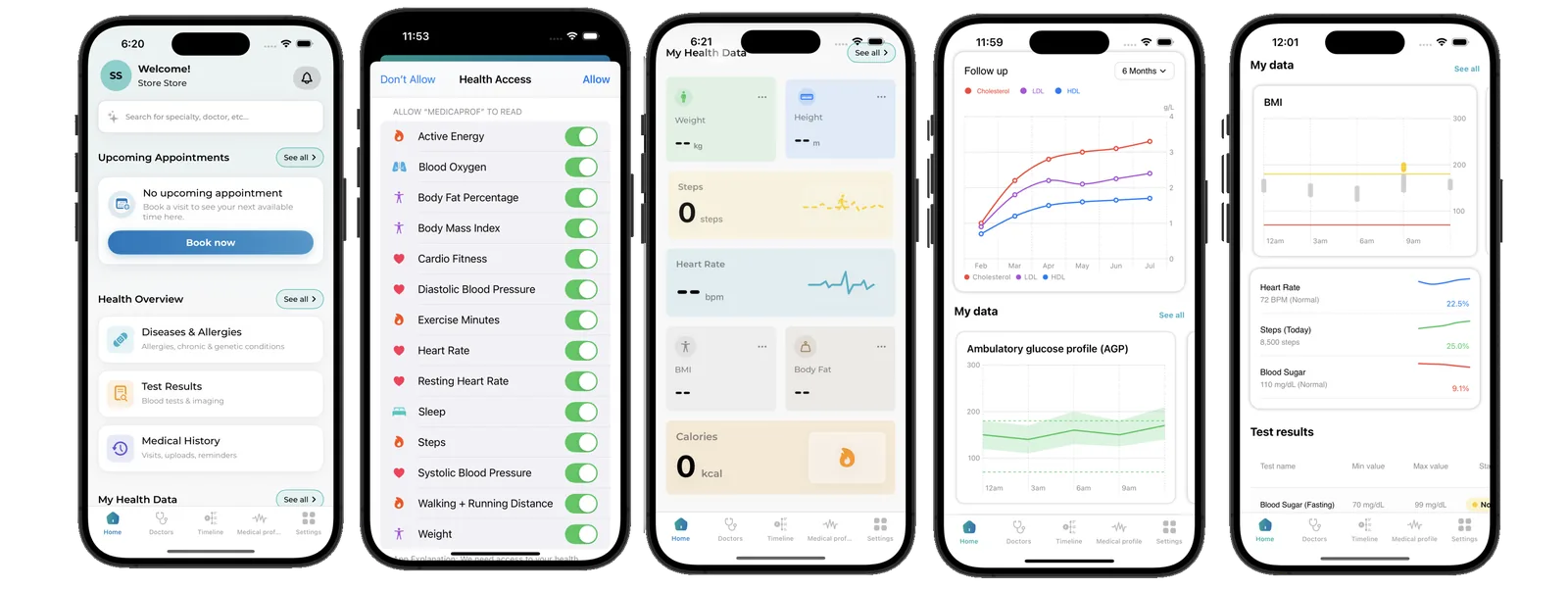
- A Home dashboard with the next appointment, profile-completion progress, Apple Health tiles and quick links.
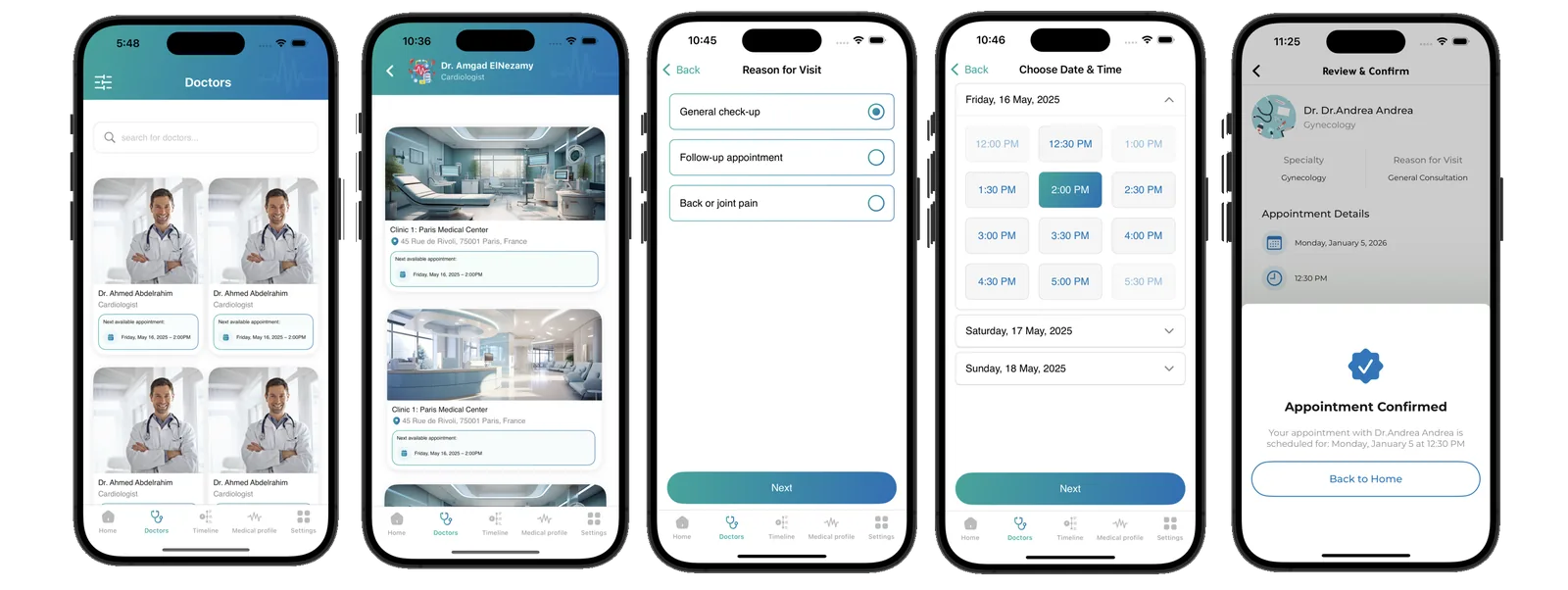
- Doctor search with specialty filters and recent searches, plus clinic and medical-centre pages with a map, weekly schedule and cancellation policy.
- Step-by-step booking: choose the patient (self or a family member), the visit reason and a time slot, then review and confirm.
- Upcoming and past appointments with details, cancellation with a reason, rescheduling and image or PDF attachments.
- Video visits that open in the app from five minutes before the start time, with Picture in Picture.
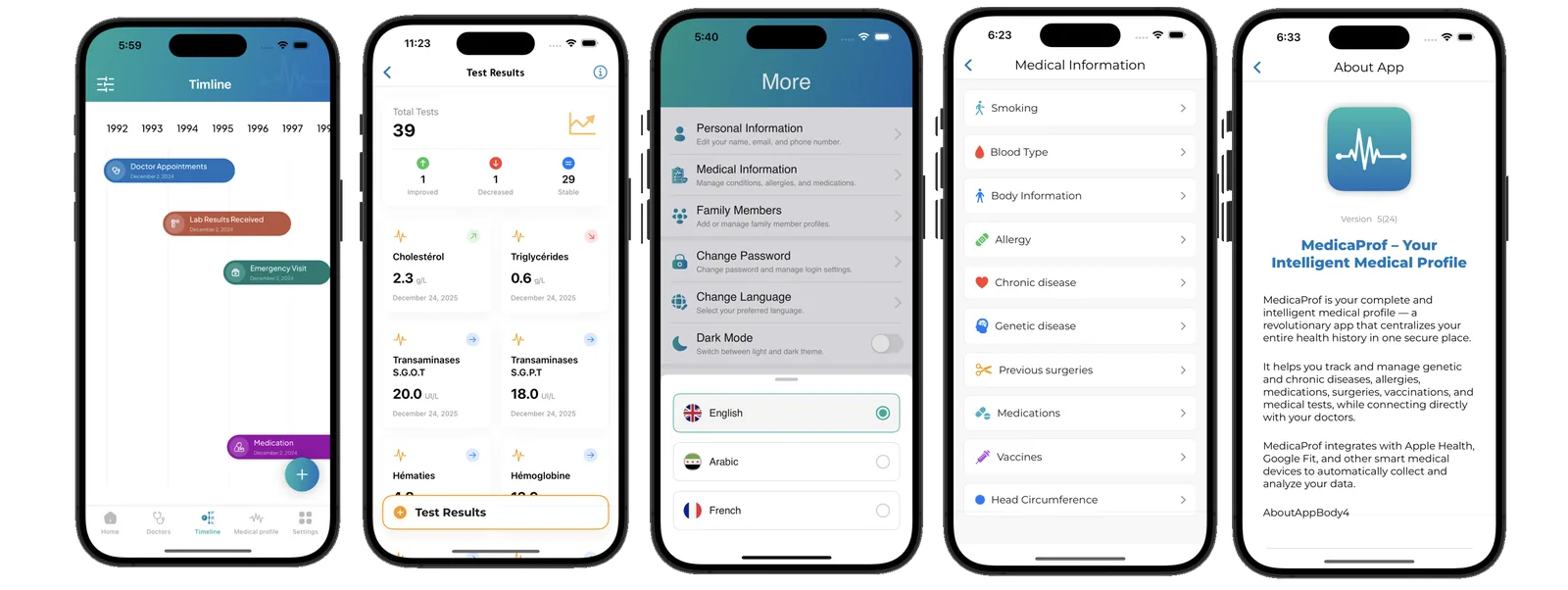
- A medical profile covering allergies, chronic and genetic diseases, medications, surgeries, vaccines, eye health, body metrics, blood type and smoking, with a first-run wizard and test-result trends.
- A medical timeline of dated events with photos and PDFs, grouped by year, with a pinch-to-zoom years grid.
- Opt-in, read-only Apple Health sync for 24 record types, with a reorderable tiles dashboard and an ECG chart.
- Family members, added with consent and legal-representative certification, that the account holder can act on behalf of.
- Push and live in-app notifications that open the right screen, plus in-app search across about 25 screens in three languages.
What I built
- A feature-modular SwiftUI architecture (MVVM, Use Case, Repository, protocol-based injection) across 8 modules and ~74k lines of Swift, with two country backends and server-driven feature flags.
- Doctor discovery and end-to-end booking (patient, visit reason, live slot availability, confirmation), cancel and reschedule, and video consultations through Jitsi with Picture in Picture.
- A background Apple Health sync for 24 data types: anchored queries, a persisted idempotent upload queue and safe handling of revoked permissions and reinstalls.
- Secure sessions: rotating refresh tokens with actor-based single-flight refresh, 2FA OTP with trusted devices, Face ID / Touch ID login and separate sessions for family members.
- Privacy for health data: device-only Keychain, no medical data cached on disk, an app-switcher blur and a compile-time ban on logging.
- An in-house design system with light and dark themes, Dynamic Type and Reduce Motion, in English, French and Arabic (RTL) with runtime language switching.
- Push notifications (Firebase) with a WebSocket live-update channel, and TestFlight delivery with fastlane and GitHub Actions.
Under the hood
- Single-flight token refresh: an actor makes concurrent 401 responses share one refresh, which runs on its own URLSession so it can never loop back into itself.
- The rotated refresh token is saved to the Keychain before anything else, and a 15-second timeout with one retry lands inside the server's 30-second grace window.
- Only a genuine authentication rejection signs the user out; offline and server errors keep the session alive.
- Family mode sends the selected member's token on every request except account-level operations (sign-in, password, deletion, family management, Apple Health, push), which stay on the account holder.
- HealthKit sync combines observer queries with background delivery, anchored queries that also capture deletions, and statistics queries for daily totals.
- Health uploads go through an actor-owned queue excluded from backup, each with a SHA-256 idempotency key and server resume points; nothing is sent after a permission is revoked, so server data can't be wiped by accident.
- One hand-written URLSession client handles JSON, form and multipart bodies, converts Arabic-Indic and Persian digits, sends the bearer token only to the app's own host and shows the backend's real error message.
- Live notifications run over a WebSocket with 20-second pings, 2–30 second reconnect backoff and custom close codes that mean refresh-and-reconnect or stop.
- The Jitsi web view grants camera and microphone only to the meeting's origin and reloads itself if the web content process crashes.
- Remote feature flags let features ship dark and fall back to safe defaults when the flags can't be fetched.
Results
- Live on the App Store.